
RAW Conversations: Creating the conditions for authentic and challenging conversations
By Mo Ford
In situations where we anticipate big or raw emotions, conflict or painful decision making processes, how we plan, set up and show up can make the difference between a traumatic event and a positive outcome. It’s true that we might bring our most grounded, thoughtful and well prepared self to a difficult situation and have a bad experience anyway – after all, we can’t control what others bring. But there are some conditions we can help to create in order to offer the best possible chance of minimising distress and impasse. Before heading into a challenging development day, performance review, bad news briefing, tense family meeting, or fraught relationship check-in, here are some things to consider, reflect on and offer:
What am I bringing into the space?
As mentioned, we can only seek to control our own actions and responses, and how we show up can influence the dynamics in the room, particularly if we hold a position of influence in the context we’re operating in. Taking time to get as grounded, present, and curious as possible can make a real difference. Reflecting in advance about any worries or anticipated struggles and how we might approach them can also be helpful.
Creating a safe container

Photo by Ryan Parker on Unsplash
I love the idea of the ‘safe container’ to describe a space that allows the people within to feel safely ‘held’ and contained enough to head into tender territory if needed. In order to feel safe enough to have sensitive or challenging conversations, most people need to know that they will not be interrupted, overheard, or have their confidentiality compromised. Having a space that offers a sense of privacy and being able to contain the conversation can help people to say what’s on their mind. The safe container can also describe a sense of permission to bring our whole selves into a space. How we welcome and help each other to ‘land’ in a space and a conversation can support an experience of psychological safety.
Other considerations in terms of physical space relate to ways in which a sense of calm, safety and focus might be achieved. Soft or natural lighting, comfortable furniture, colour schemes evoking a sense of warmth, welcome and calm, and minimising background noise can evoke safety and comfort. It can be particularly challenging for many (especially neurodivergent) people to stay calm and present in environments where they are straining to hear over background noise or crammed into small spaces with harsh lighting. There may be a limit to what’s possible in terms of physical environment, but it can be worth making small changes, or booking a space that fits the ‘safe container’ brief.
Does ‘what’s said in the room stay in the room’?
I often hear this nod to confidentiality being brought up during contracting and group agreement discussions. I’m too much of a literal thinker to use ‘what’s said in the room stays in the room’ without caveats, because it seems impossible to agree that nothing can be referenced afterwards. What’s usually meant by this is not sharing others’ personal or sensitive information without their explicit permission. This helps people to contribute more authentically, and is an integral part of contracting. But another idea occurs to me when I think about things staying in the room – this is about boundaries, and doing what needs to be done to let go of what came before the session, then drawing a boundary around the conversation afterwards. It’s not a ‘leave your emotions at the door’ approach so much as putting a buffer around challenging conversations in order to be more present. Achieving this might involve scheduling ten minutes before and after the session for shifting focus, landing and decompressing.
The power of human connection
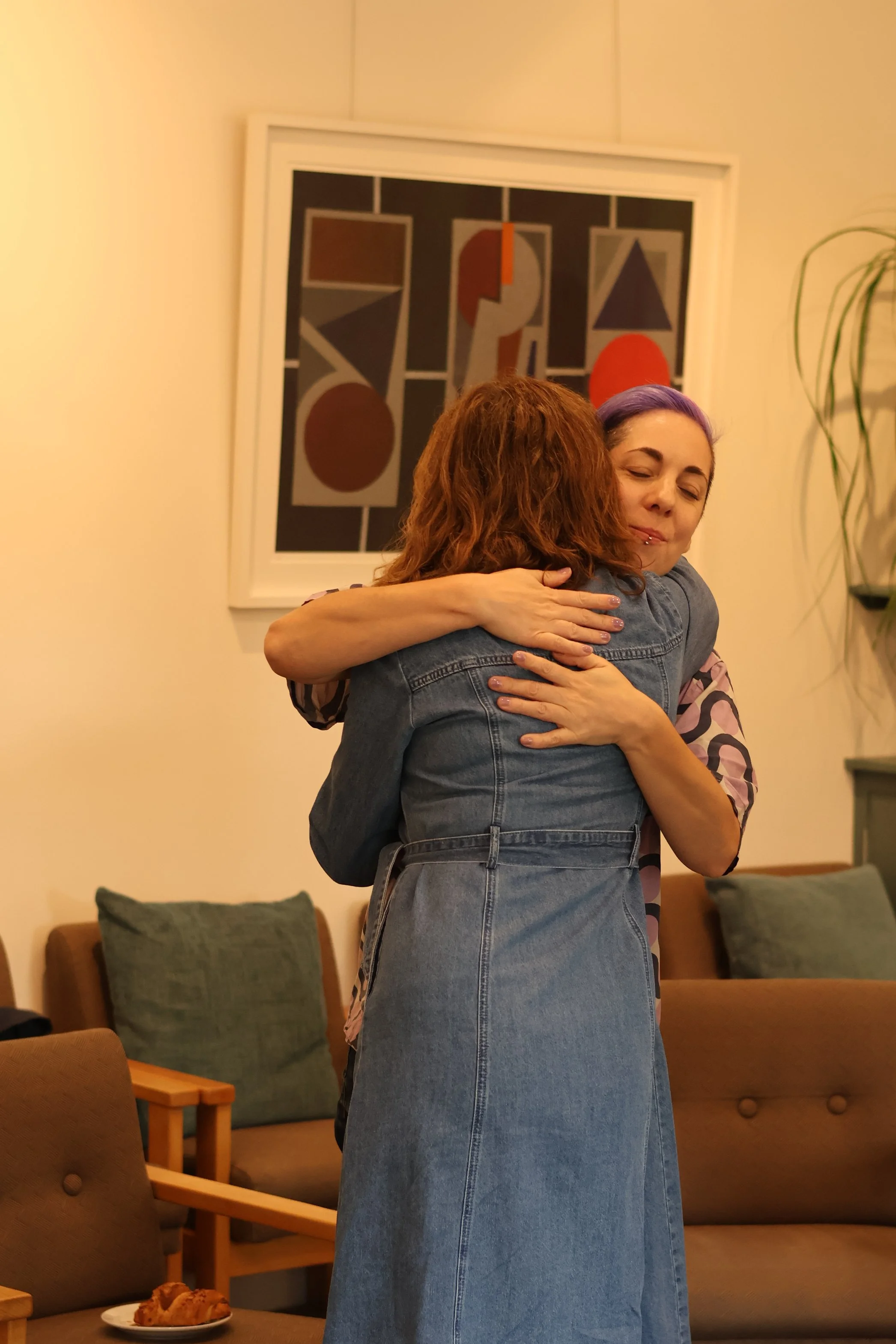
Mo Ford & Jane Bytheway - Oasis Practitioner Community Event 2025
Perhaps the most important condition for me is not underestimating the power of connection and rapport building. We all have different preferences – for example, I can see small talk for the potentially useful and low risk bid for connection that it is, but I don’t feel especially at home with it. Some unstructured chatting time to ease the transition and build rapport can be helpful if it doesn’t come with pressure to engage for those who need a different approach. Ice breakers and check-ins can elicit ‘love or loathe’ reactions, depending on the context, individual preferences and the presence of conflicts or challenges that feel raw and close to the surface. I once facilitated a development day for an organisation that was much deeper into a relational crisis than I’d expected. My initial attempts at facilitating an in-depth check-in and leading ‘fun’ trust-building exercises ahead of the main events of the day were met with a spectrum of responses from relief to abject horror. It quickly became clear that this was a group in need of a slower, more contained intervention in order to begin the process of rebuilding trust and safety. But, cautionary tales aside, a thoughtful approach to difficult conversations and processes with anything that reminds all involved of their shared humanity can be a powerful antidote to the dehumanising effects and two-dimensional views that can emerge in conflict. I’m generally a big fan of starting challenging conversations with a check-in to let everyone say how they are and anything they might need, though this is best offered with context-appropriate levels of choice and depth.
Permission to be vulnerable
Vulnerability is a word that evokes a range of associations, from seeing it as a strength that requires courage to express, to equating it with weakness and learned helplessness. What I mean by ‘expressing vulnerability’ in this context is showing elements of our messy, fallible humanity and our inner world, which involves a level of social risk and, therefore, courage. In difficult conversations, vulnerability needs to be handled with care and brought into the room with consent. We cannot demand vulnerability or social and emotional risk taking from another person, especially where there is an imbalance of power, or the likelihood of real negative repercussions. If someone is worried that an honest response might cost them their job, it seems less likely and less reasonable for them to offer that response. But a Whole Person approach acknowledges and gives permission for all involved to safely make mistakes, change their mind, show emotion, need support, and at the same time, be capable, creative, independent, and experts in their own experience.
This applies to all equally, regardless of position in a hierarchy or role. We can view people’s vulnerability and humanity through different lenses, depending on their identities and roles – I’ve worked with plenty of leaders who struggle to show vulnerability because they feel that others rely on them to be strong and in control. Gender, age/generation, culture, and socioeconomic background can influence our ideas and feelings of (dis)comfort with being vulnerable and imperfect. Contracting that gives explicit permission to express feelings, make mistakes and need support can help people to come into a challenging situation without the additional effort, distraction and anxiety that can come with maintaining a veneer of control and being ‘fine’ when something feels wrong. Of course, there are contextual limits to what’s possible and useful in relation to vulnerability and how much it’s safe and appropriate to share. But in situations where it’s anticipated that emotions may run high, conflict may arise, or decision making will be difficult, permission to express and name feelings can help to take some heat out of the situation, and additionally remind us of our shared humanity. The next consideration is what we do with these feelings and responses… Which brings me to my last point:
Balancing autonomy and responsibility
Firstly, letting people know that they have choice is important, especially in situations where responses might be influenced by a sense of being ‘done to’, powerlessness, or injustice. Reminders of where people do have autonomy can contribute to a sense of safety – for example, knowing that it’s possible to take a break if we get overwhelmed may reduce the risk of actually experiencing overwhelm. Levelling the playing field can help everyone connect with their most Adult responses. But this comes with an individual responsibility to attempt to engage in good faith, and to take steps to self-regulate if we notice signs that we are becoming heightened or stressed. That doesn’t negate the role of collective care, or coldly require someone having a distressing experience to manage it by themselves; rather, it’s about considering the balance of individual and group needs. It’s not an easy balance to strike, but can be helped by good contracting and discussion about expectations, permissions, needs and shared goals.
Of course, none of this is a magic wand that will remove discomfort from difficult conversations. But leaning into and learning from the uncomfortable parts can be powerful, and creating the conditions to do this from a place of calm, safety and curiosity can transform the experience into a challenging, yet positive one.
Our RAW (Resilience, Adaptability and Wellbeing) Team offer practical ways to turn awareness into lasting change - from workshops and coaching to organisation-wide wellbeing strategies. Learn more about our approach